
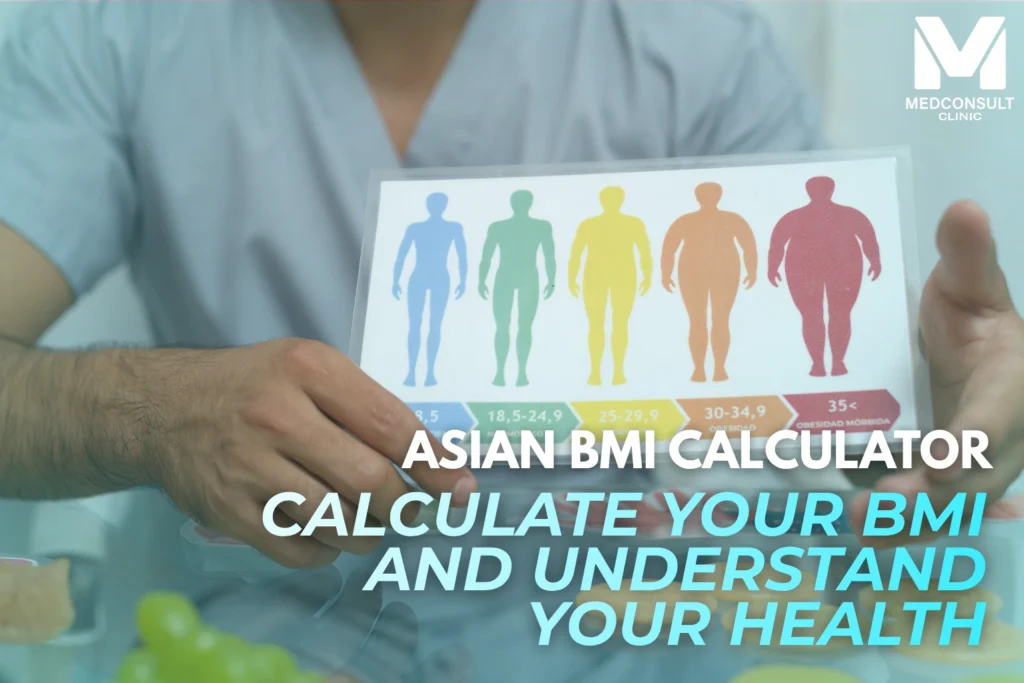
Asian BMI Calculator
Calculate your BMI and understand what your result may mean for your health. For Asian populations, BMI thresholds used to assess overweight and obesity can be lower than those commonly used in Western populations.
Calculate Your BMI
Enter your:
Height:
[ ___ ] cm
Weight:
[ ___ ] kg
Calculate BMI
Your BMI
BMI: [XX.X] kg/m²
Your BMI Category
| BMI | Category |
|---|---|
| Below 18.5 | Underweight |
| 18.5–22.9 | Healthy weight |
| 23.0–24.9 | Overweight |
| 25.0 and above | Obesity |
Note: BMI is a screening measurement and does not directly measure body fat, muscle mass, or overall health.
What Is BMI?
BMI, or Body Mass Index, is a simple measurement based on your height and weight.
The calculation is:
BMI = weight (kg) ÷ height² (m)
For example, someone weighing 70 kg and measuring 1.70 m would have a BMI of approximately 24.2 kg/m².
BMI is commonly used as a starting point when assessing weight-related health risks.
However, it should not be considered a diagnosis by itself.
Why Is Asian BMI Different?
You may have noticed that BMI categories can differ depending on the population being assessed.
Research has shown that Asian populations can have a higher percentage of body fat and more visceral fat at the same BMI compared with some other populations.
Because of this, health risks associated with excess weight may occur at lower BMI levels.
For example, the STEP 11 clinical trial conducted in Thailand and South Korea used BMI ≥25 kg/m² as the definition of obesity, reflecting local guidance for Asian populations.
The study also used:
- BMI ≥23 kg/m² as the threshold for overweight
- BMI ≥25 kg/m² as the threshold for obesity
This does not mean that everyone with a BMI of 25 needs treatment. BMI is one part of a wider health assessment.
What Does Your BMI Mean?
BMI Below 18.5
This is generally classified as underweight.
Being underweight may have different causes, including low calorie intake, underlying medical conditions, or changes in muscle mass.
If you have experienced unexplained weight loss, it may be worth discussing this with a doctor.
BMI 18.5–22.9
This range is generally considered a healthy BMI range using Asian-specific thresholds.
However, a healthy BMI does not necessarily mean that all aspects of your health are optimal.
Blood pressure, blood sugar, cholesterol, lifestyle, and family history can also affect your health.
BMI 23–24.9
This range may be considered overweight using Asian BMI criteria.
At this level, it may be useful to look at other indicators of metabolic health, particularly if you have increasing waist circumference, high blood pressure, high cholesterol, or elevated blood sugar.
BMI 25 or Above
Using the Asian thresholds referenced in the STEP 11 study, BMI ≥25 kg/m² is classified as obesity.
This does not automatically mean that medication or a weight-loss programme is necessary.
A doctor may look at your overall health, previous weight-loss attempts, waist circumference, blood sugar, blood pressure, cholesterol, and other factors before recommending an approach.
Is BMI Enough to Measure Your Health?
Not always.
BMI does not tell you how much of your weight comes from muscle or fat, or where your body stores fat.
For a more complete assessment, a healthcare professional may also consider:
- Waist circumference
- Body composition
- Blood pressure
- Blood glucose
- HbA1c
- Cholesterol
- Liver health
- Kidney function
- Medical history
- Family history
- Lifestyle
This is particularly relevant for Asian patients because metabolic risk may occur at a lower BMI.
Why Waist Circumference Matters
Where your body stores fat can be important.
Visceral fat is fat stored around internal organs and is associated with metabolic health risks.
Someone can have a BMI that does not appear particularly high but still have increased abdominal fat.
This is why measuring waist circumference alongside BMI can provide additional information.
BMI and Weight Loss
If your BMI is above the healthy range, this does not necessarily mean you need to lose weight immediately or use medication.
The appropriate approach depends on your individual circumstances.
Some people may benefit from:
- Nutrition changes
- Increased physical activity
- Strength training
- Improved sleep
- Stress management
- Regular health monitoring
Others may benefit from structured medical weight management.
The first step is understanding your overall health.
When Should You Consider Medical Weight Management?
You may consider speaking with a doctor if:
- Your BMI is 25 or above
- You have repeatedly struggled to lose weight
- You experience weight regain
- You have high blood pressure
- You have high cholesterol
- You have prediabetes
- You have insulin resistance
- You have fatty liver concerns
- You have PCOS
- Weight is affecting your daily life or health
A doctor can help determine whether lifestyle support, monitoring, or medical treatment may be appropriate.
What a Doctor May Assess
A doctor-led weight assessment may include:
- BMI calculation
- Waist circumference
- Weight history
- Medical history
- Blood pressure
- Blood tests if needed
- HbA1c
- Fasting blood glucose
- Cholesterol
- Liver function
- Kidney function
- Current medications
- Lifestyle factors
- Weight-management options
This provides a more complete picture than BMI alone.
BMI Calculator: Important Things to Remember
Your BMI is useful, but it is only a starting point.
Remember:
- BMI does not directly measure body fat
- Muscle mass can affect BMI
- Waist circumference can provide additional information
- Asian populations may face metabolic risks at lower BMI levels
- BMI does not diagnose a medical condition
- Your health history matters
- Treatment decisions should not be based on BMI alone
A BMI calculator can help you understand where you currently stand, but a doctor can help explain what the number means in the context of your health.
Frequently Asked Questions
How is BMI calculated?
BMI is calculated by dividing your weight in kilograms by your height in metres squared.
BMI = weight (kg) ÷ height² (m)
Is BMI 25 considered obese for Asians?
Using the Asian-specific thresholds referenced in the STEP 11 study, BMI ≥25 kg/m² is classified as obesity. However, BMI should be considered alongside other health measurements.
Is BMI accurate for everyone?
No. BMI does not distinguish between muscle and fat and does not show where fat is stored. It should be used as a screening tool rather than a complete health assessment.
What should I do if my BMI is high?
A high BMI does not automatically mean you need medication. Consider discussing your result with a healthcare professional who can assess your overall health and risk factors.
References
- World Health Organization – The Asia-Pacific Perspective: Redefining Obesity and Its Treatment
WHO – The Asia-Pacific Perspective - World Health Organization – Obesity and Overweight
WHO – Obesity and Overweight - Lim S, Buranapin S, Bao X, et al. – STEP 11 Trial
Once-weekly semaglutide 2.4 mg in an Asian population with obesity, defined as BMI ≥25 kg/m², in South Korea and Thailand. The Lancet Diabetes & Endocrinology. 2025.
The Lancet – STEP 11 Trial - Tham KW, Abdul Ghani R, Cua SC, et al. – Obesity in South and Southeast Asia
Obesity in South and Southeast Asia—a new consensus on care and management. Obesity Reviews. 2023;24:e13520. - Korean Society for the Study of Obesity – Clinical Practice Guidelines for Obesity
Diagnosis of obesity: 2022 update of clinical practice guidelines for obesity by the Korean Society for the Study of Obesity. Journal of Obesity & Metabolic Syndrome. 2023;32:121–129.