
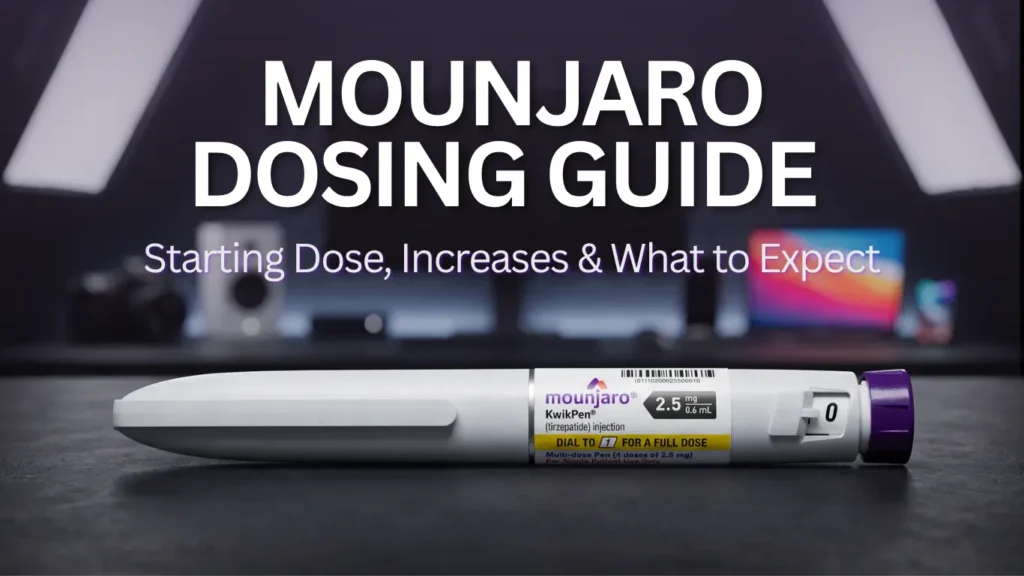
Mounjaro Dosing Information: Starting Dose, Dose Increases and What to Expect
If your doctor has prescribed Mounjaro, one of the first questions you may have is how the dosing works.
Mounjaro contains tirzepatide, a once-weekly injectable prescription medicine used alongside diet and exercise to improve blood sugar control in adults and children aged 10 years and older with type 2 diabetes.
In adults with type 2 diabetes who are at high risk of cardiovascular events, Mounjaro is also approved to reduce the risk of major cardiovascular events such as cardiovascular death, non-fatal heart attack, or non-fatal stroke.
Mounjaro is not a medication that starts at the highest dose. Treatment begins at a lower dose and may be increased gradually depending on your response, blood sugar goals, and tolerability.
Understanding the dosing schedule can help patients know what to expect and why dose changes should always be made with medical guidance.
What Is Mounjaro?
Mounjaro is the brand name for tirzepatide.
Tirzepatide works on two hormone pathways:
GIP, or glucose-dependent insulinotropic polypeptide
GLP-1, or glucagon-like peptide-1
These pathways are involved in:
Blood sugar regulation
Insulin response
Appetite
Digestion
Energy balance
For patients with type 2 diabetes, Mounjaro is used together with diet and exercise to help improve glycemic control.
What Is the Starting Dose of Mounjaro?
The recommended starting dose for adults is:
2.5 mg once weekly
The purpose of starting at 2.5 mg is to begin treatment gradually and allow the body to adjust.
The starting dose is not selected based only on body weight.
Your doctor will consider your overall health, blood sugar control, current medications, and treatment goals.
What Happens After the Starting Dose?
After at least 4 weeks on the current dose, your doctor may consider increasing the dose if additional blood sugar control is needed.
Dose increases are made in 2.5 mg increments.
Possible dose strengths include:
2.5 mg
5 mg
7.5 mg
10 mg
12.5 mg
15 mg
Not every patient needs to reach the highest dose.
Your doctor may keep you on the same dose for longer if your treatment is working well or if you are experiencing side effects.
Why Is the Dose Increased Gradually?
Gradual dose increases help balance treatment effectiveness with tolerability.
Mounjaro can cause gastrointestinal side effects, particularly when treatment begins or the dose increases.
Common side effects may include:
Nausea
Diarrhoea
Reduced appetite
Vomiting
Constipation
Indigestion
Abdominal discomfort
For some patients, increasing the dose too quickly may make these symptoms harder to tolerate.
This is why dose escalation should follow medical guidance rather than patient preference alone.
What Is the Maximum Mounjaro Dose for Adults?
The maximum recommended dose for adults is:
15 mg once weekly
However, reaching 15 mg is not automatically the goal for every patient.
Your maintenance dose depends on:
Blood sugar response
HbA1c goals
Side effects
Tolerability
Overall treatment response
Other medications
Medical history
A lower dose may be appropriate if it provides adequate blood sugar control.
How Often Is Mounjaro Used?
Mounjaro is administered:
once every week
It can be taken:
At any time of day
With or without food
Patients should aim to use it on the same day each week to make treatment easier to remember.
A reminder on your phone or calendar can be useful for maintaining a consistent schedule.
Where Is Mounjaro Injected?
Mounjaro is given as a subcutaneous injection.
Approved injection areas include:
Abdomen
Thigh
Back of the upper arm when administered by another person
Injection sites should be rotated with each dose.
Do not repeatedly inject into exactly the same location.
What Mounjaro Strengths Are Available?
Mounjaro is available in multiple strengths.
Current prescribing information lists:
2.5 mg
5 mg
7.5 mg
10 mg
12.5 mg
15 mg
Different markets may use different device formats, including single-dose pens, single-dose vials, multi-dose vials, or KwikPens.
Patients should follow the instructions provided with the exact product they receive.
How Many Doses Are in a Mounjaro KwikPen?
The current Mounjaro KwikPen presentation is designed for four weekly doses per pen.
Each pen is supplied for a specific dose strength.
For example, a KwikPen may provide four weekly doses of:
2.5 mg
5 mg
7.5 mg
10 mg
12.5 mg
15 mg
Patients should not assume that pens are interchangeable or adjust the dose by counting clicks unless specifically instructed for that exact device by a qualified healthcare professional.
What Happens at Your Follow-Up Appointment?
During follow-up, your doctor may ask:
How your blood sugar has changed
Whether your appetite has changed
Whether you have side effects
Whether you are tolerating the medication
Whether your HbA1c is improving
Whether your dose should stay the same or change
A dose increase is not automatic.
Your doctor may decide to keep you on the same dose for longer than 4 weeks depending on your response.
What a Doctor May Assess Before Increasing the Dose
A doctor-led review may include:
Blood sugar readings
HbA1c
Side effects
Weight changes
Appetite changes
Hydration
Digestive symptoms
Current diabetes medications
Kidney function if appropriate
Treatment goals
This helps ensure that dose adjustments are based on clinical need rather than a fixed timetable alone.
Mounjaro and Other Diabetes Medications
Patients taking Mounjaro together with certain diabetes medicines may need closer monitoring.
For example, using Mounjaro with:
Insulin
Sulfonylureas
may increase the risk of hypoglycemia.
Your doctor may need to review your overall diabetes treatment plan if Mounjaro is added or the dose is increased.
Do not change another diabetes medication without medical advice.
Common Side Effects to Watch For
The most commonly reported side effects include:
Nausea
Diarrhoea
Decreased appetite
Vomiting
Constipation
Indigestion
Abdominal pain
These symptoms may be more noticeable during dose escalation.
Contact your doctor if symptoms are:
Severe
Persistent
Affecting hydration
Preventing normal eating
Associated with significant abdominal pain
Important Safety Considerations
Mounjaro is not suitable for everyone.
Important considerations include a personal or family history of:
Medullary thyroid carcinoma
Multiple Endocrine Neoplasia syndrome type 2
Mounjaro should also not be used by patients with a known serious hypersensitivity to tirzepatide or its ingredients.
Other conditions, such as a history of pancreatitis or severe gastrointestinal symptoms, should be discussed with your doctor before treatment.
Can You Increase the Dose Faster?
No.
Dose increases should not be made more frequently than recommended.
Current prescribing information states that dose increases should occur only after at least 4 weeks on the current dose if additional glycemic control is needed.
Increasing the dose faster may increase the risk of side effects without providing additional benefit.
Can You Stay on a Lower Dose?
Yes.
Not every patient needs to increase to the maximum dose.
If your blood sugar is improving and the medication is well tolerated, your doctor may choose to maintain the current dose.
The treatment plan should be individualised.
What About Mounjaro for Children?
Mounjaro is approved for children aged 10 years and older with type 2 diabetes.
For this age group, the maximum recommended dose is:
10 mg once weekly
This article focuses mainly on adult dosing.
Pediatric treatment should be managed by a healthcare professional experienced in diabetes care for children and adolescents.
Why Doctor-Led Dosing Matters
Mounjaro dosing should not be based on:
Online dose charts
Social media advice
Another patient’s dose
How quickly you want results
Pen click counting
Your dose should be based on medical need, blood sugar response, and tolerability.
The goal is not to reach the highest dose.
The goal is to find an effective and appropriate dose for your health.
Mounjaro Consultation at MedConsult Clinic
Patients using Mounjaro for type 2 diabetes may benefit from regular medical review.
At MedConsult Clinic, a consultation may include:
Medication review
HbA1c monitoring
Blood glucose assessment
Side-effect review
Dose discussion
General metabolic health assessment
If you are already taking Mounjaro, bring your current pen, medication list, and recent blood test results if available.
What is the starting dose of Mounjaro?
The recommended starting dose for adults is 2.5 mg once weekly.
How often can the Mounjaro dose be increased?
If additional glycemic control is needed, the dose may be increased in 2.5 mg increments after at least 4 weeks on the current dose.
What is the maximum Mounjaro dose for adults?
The maximum recommended adult dose is 15 mg once weekly.
Do I have to increase my Mounjaro dose every 4 weeks?
No. A doctor may keep you on the same dose longer depending on your blood sugar response and tolerability.
References
U.S. Food and Drug Administration
Mounjaro (tirzepatide) Prescribing Information, 2026.
Eli Lilly and Company
Mounjaro Patient and Prescribing Information.
American Diabetes Association
Standards of Care in Diabetes.
SURPASS Clinical Trial Programme
Clinical studies evaluating tirzepatide in patients with type 2 diabetes.