
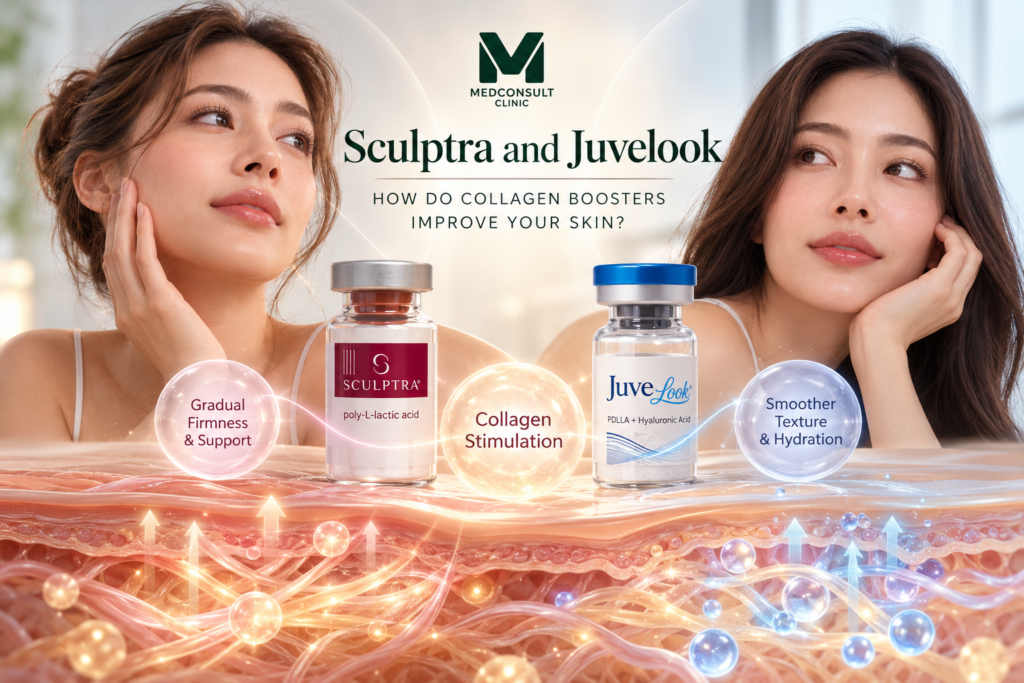
Sculptra and Juvelook: How Do Collagen Boosters Improve Your Skin?
Healthy-looking skin is not only about what we see on the surface. Beneath the skin lies a complex network of collagen, elastin, and other structural components that influence firmness, smoothness, and elasticity.
As we age, changes in collagen production and skin structure can lead to fine lines, reduced facial fullness, uneven texture, and a gradual loss of firmness.
Sculptra and Juvelook are two injectable aesthetic treatments designed to work with the skin’s underlying structure. Both use biostimulatory materials that encourage collagen formation, although their formulations and treatment applications differ.
For people exploring collagen skin boosters in Bangkok, understanding how these treatments work can help clarify which skin concerns they are designed to address, how results develop, and what to expect during treatment.
What Are Collagen Skin Boosters?
Collagen skin boosters are aesthetic treatments that aim to improve aspects of skin quality by supporting the structure or hydration of the skin.
Collagen is a structural protein found naturally throughout the body. In the skin, it provides strength and contributes to a firm, smooth appearance.
With increasing age and cumulative sun exposure, collagen fibers undergo changes that may contribute to:
Fine lines and facial wrinkles
Reduced skin firmness and elasticity
Changes in facial volume
Uneven skin texture
Crepey or thinner-looking skin
More noticeable folds and facial contours
Traditional hyaluronic acid skin boosters primarily focus on hydration and skin quality. Collagen biostimulators work differently by encouraging tissue responses associated with new collagen formation. juvelook profhilo rejuran
Sculptra and Juvelook belong to this broader category of collagen-focused injectable treatments.
Although both may improve visible signs of skin aging, they are not identical products or direct substitutes for every skin concern.
What Is Sculptra and How Does It Work?
Sculptra is an injectable collagen biostimulator containing poly-L-lactic acid (PLLA), a biodegradable synthetic material used in aesthetic medicine.
Rather than relying entirely on immediate filling, Sculptra helps stimulate the body’s natural collagen-building response within treated facial tissues.
How Sculptra Stimulates Collagen
Once Sculptra is placed into an appropriate tissue layer, its PLLA microparticles interact with surrounding tissue.
This process supports the activity of fibroblasts, the cells responsible for producing collagen and other important structural components of the skin.
Over time, newly formed collagen can contribute to improvements in facial skin support, wrinkle appearance, and the appearance of certain areas affected by volume loss.
The PLLA material gradually breaks down, while the collagen response develops over weeks and months.
Because collagen formation takes time, Sculptra is associated with gradual rather than instantly completed results.
What Skin Concerns Can Sculptra Address?
Sculptra is used for selected facial concerns, including:
Shallow to deeper facial folds
Fine lines and wrinkles in the cheek region
Changes in facial contours related to tissue volume loss
Reduced skin firmness in appropriate treatment areas
Certain visible changes associated with facial aging
The treatment can be appealing to people interested in subtle improvements that develop progressively.
Sculptra’s established uses include correction of facial wrinkles and contour deficiencies. Results depend on facial anatomy, product placement, the number of treatment sessions, and individual tissue response.
How Long Do Sculptra Results Last?
Sculptra is known for its gradual development and potentially long-lasting results.
Clinical evidence supporting approved facial applications has demonstrated improvement lasting up to 24 months in some patients.
However, this does not mean that every person will experience the same duration or degree of improvement.
Age, facial structure, skin condition, lifestyle, treatment area, and individual collagen response all contribute to the final appearance.
What Is Juvelook and How Does It Work?
Juvelook is an injectable product containing two important components:
Poly-D,L-lactic acid (PDLLA) and hyaluronic acid (HA).
The combination is designed to provide both a tissue-supporting biostimulatory effect and benefits associated with hyaluronic acid.
PDLLA is a biodegradable material that can encourage collagen formation as the tissue responds to its presence.
Hyaluronic acid is a naturally occurring substance with the ability to attract and retain water, making it widely used in aesthetic treatments focused on hydration and tissue appearance.
How Juvelook Supports Skin Rejuvenation
Juvelook combines two mechanisms.
1. Hyaluronic acid and initial tissue support
The hyaluronic acid component contributes to the formulation’s initial tissue-filling and water-binding properties.
These effects can influence the early appearance of the treated area, although initial swelling can also affect what is visible immediately after treatment.
2. PDLLA and gradual collagen formation
PDLLA microparticles provide a biostimulatory effect that encourages the formation of new collagen within treated tissues.
Over time, this process may contribute to improvements in skin texture, fine lines, and selected contour concerns.
The combination offers a different treatment profile from products containing PLLA alone.
What Skin Concerns Can Juvelook Address?
Juvelook has been studied for several aesthetic concerns, including:
Fine lines and wrinkles
Uneven skin texture
Changes in skin elasticity
Certain depressed acne scars
Selected facial folds
Skin rejuvenation in specific facial areas
Research involving PDLLA and hyaluronic acid has reported improvements in several skin-quality measures, including texture and wrinkles.
However, the available studies are relatively small, and clinical evidence continues to develop.
The Juvelook product range also includes multiple formulations with different amounts of active ingredients. Product selection and suitable treatment areas depend on the specific formulation.
Sculptra and Juvelook: Understanding Their Different Benefits
Both treatments are associated with collagen stimulation, but their formulations and intended applications are not exactly the same.
| Feature | Sculptra | Juvelook |
|---|---|---|
| Main ingredients | Poly-L-lactic acid (PLLA) | Poly-D,L-lactic acid (PDLLA) and hyaluronic acid |
| Main approach | Gradual collagen stimulation and structural support | Collagen stimulation with hyaluronic acid |
| Common treatment focus | Selected facial folds, wrinkles, and contour concerns | Skin texture, fine lines, and selected facial concerns |
| Development of results | Progressive over weeks and months | Initial tissue effects followed by gradual changes |
| Treatment sessions | Often multiple sessions | Often multiple sessions |
| Duration of results | Some clinical results lasting up to 24 months | Duration varies; longer-term evidence is still developing |
A treatment focused on changes in facial structure may require a different approach from one focused primarily on fine lines or uneven texture.
Neither treatment is automatically the better option for every individual.
The most relevant factors include the specific skin concern, facial anatomy, treatment history, and the result a person hopes to achieve.
Why Is Collagen Important for Younger-Looking Skin?
Collagen is one of the key structural proteins in the dermis, the layer of skin beneath the epidermis.
Its network of fibers provides support to the skin and contributes to its overall appearance and mechanical strength.
As the skin ages, several changes occur:
1. Collagen Production Changes
Over time, the balance between collagen production and breakdown changes.
This contributes to gradual changes in the skin’s structural framework, making wrinkles and reduced firmness more noticeable.
2. Skin Elasticity Decreases
Collagen works alongside elastin and other components of the extracellular matrix.
As these structures change, the skin can become less resilient, and certain facial expressions or folds may become more visible.
3. Facial Volume Changes
Facial aging also involves changes in fat distribution, connective tissues, and underlying bone.
These changes can influence how the skin rests over the face, creating areas that appear flatter or more hollow.
Collagen-focused treatments can address selected aspects of skin structure, but they cannot reverse every feature of facial aging.
4. Environmental Exposure Influences Skin Quality
Ultraviolet radiation, smoking, and other environmental factors can contribute to collagen degradation and changes in skin appearance.
Daily sunscreen use and consistent skincare remain important parts of maintaining skin health, even when aesthetic treatments are included.
What Results Can You Expect From Collagen Boosters?
One of the defining features of collagen biostimulators is that visible improvements usually develop gradually.
Immediately after treatment, the skin may appear fuller because of the injected solution and temporary swelling.
As this initial effect settles, the longer-term tissue response develops.
During the First Few Weeks
Early changes may include subtle improvements in the appearance of treated areas.
Bruising, swelling, or tenderness can temporarily affect the appearance of the skin during this period.
Over the Following Months
Collagen remodeling continues as the tissue responds to the biostimulatory material.
Depending on the product and treatment area, changes may become more noticeable in facial texture, the appearance of wrinkles, or contour support.
Longer-Term Results
Some collagen-stimulating treatments can produce changes that remain visible for many months.
Sculptra has longer-term clinical evidence for particular facial indications. For Juvelook, research is growing, but duration varies with formulation and treatment application.
Importantly, collagen stimulation is not an instant transformation, and results are not guaranteed.
A realistic goal is improvement in selected aesthetic concerns while preserving natural facial characteristics.
How Many Treatment Sessions Are Usually Needed?
The number of sessions varies according to the product, treatment area, and individual response.
For Sculptra, treatment commonly involves approximately two to three sessions over several months, although individual treatment plans may differ.
For Juvelook, published studies have frequently used two or three sessions at intervals of approximately four to six weeks.
These research schedules are not a universal treatment plan.
The quantity of product, interval between appointments, and total number of sessions depend on the formulation, treatment technique, skin condition, and intended result.
Some patients may require fewer sessions, while others may require additional treatment to address their specific concerns.
What Happens During a Collagen Booster Appointment?
A collagen booster appointment generally begins with an assessment of the treatment area and the person’s aesthetic goals.
Skin texture, facial contours, previous aesthetic procedures, allergies, and relevant medical history are among the factors considered.
Before Treatment
The intended treatment area is examined, and the available options are discussed.
The specific product, expected changes, possible side effects, and aftercare instructions are explained before the procedure.
During Treatment
The skin is cleaned and prepared.
The selected injectable product is administered using a technique appropriate for its formulation and approved treatment area.
Treatment time varies with the number of areas being addressed.
After Treatment
Temporary redness, swelling, bruising, or tenderness may occur at the treated sites.
Many people can return to ordinary daily activities after treatment, although individual recovery experiences differ.
Aftercare instructions are product-specific. For example, Sculptra has particular post-treatment massage guidance that differs from the instructions used for some other injectables.
Following the instructions supplied for the individual treatment is important.
Can Collagen Boosters Help With Facial Changes After Weight Loss?
Significant weight loss can sometimes make changes in facial volume and skin firmness more noticeable.
These changes may include:
Reduced cheek fullness
More visible facial folds
Changes around the lower face
Reduced skin firmness
A less rounded facial appearance
Not all of these changes are caused by collagen loss.
Facial fat distribution, tissue elasticity, age, genetics, and the amount and speed of weight loss can all influence facial appearance.
Collagen-stimulating treatments may help address selected skin and contour concerns, but they do not recreate the entire facial fat structure or provide a substitute for every type of volume-restoring treatment.
Some people are happy with their facial appearance after weight loss and prefer no aesthetic treatment.
For those exploring their options, understanding the difference between changes in skin quality and changes in facial volume is a useful starting point. for more information https://www.medconsultasia.com/weight-loss/
Sculptra and Juvelook in Bangkok
Bangkok offers a wide range of aesthetic treatments, including collagen biostimulators, dermal fillers, skin boosters, and energy-based skin procedures.
For people interested in Sculptra and Juvelook in Bangkok, the treatment decision involves more than simply selecting a product name.
Different skin concerns may benefit from different approaches. A treatment focused on skin texture has a different purpose from one intended to address deeper contour changes.
At MedConsult Clinic, aesthetic services are available for both local residents and international patients, with English-speaking medical professionals and convenient locations in Thonglor and Silom.
Our approach focuses on understanding individual treatment goals and providing clear information about available aesthetic options.
Explore our aesthetic services in Bangkok to learn more about treatments for facial lines, skin quality, and facial rejuvenation.
Frequently Asked Questions
Is Juvelook a collagen booster?
Juvelook is commonly described as a hybrid collagen booster or biostimulatory injectable because it combines PDLLA with hyaluronic acid. Different Juvelook formulations have different product specifications.
Are collagen boosters suitable for every skin type?
Skin type alone does not determine suitability. Medical history, allergies, previous procedures, scarring tendencies, active skin conditions, and treatment goals also matter
Do collagen boosters replace traditional fillers?
Not necessarily. Collagen biostimulators and conventional fillers act through different mechanisms. Some treatments primarily add volume, while others encourage gradual structural changes.