
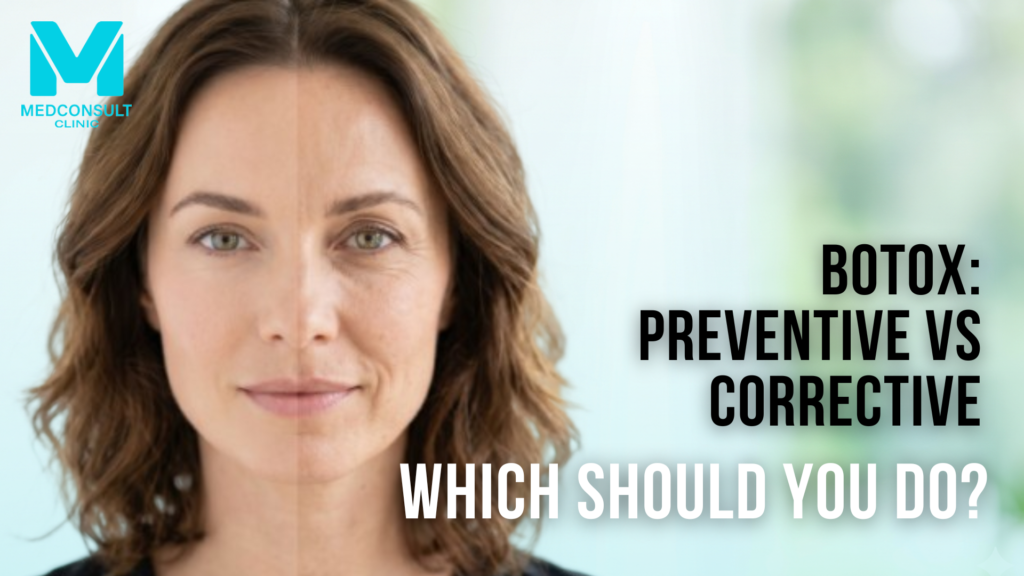
Introduction
Botox has become one of the most widely used aesthetic treatments for managing wrinkles and maintaining a refreshed appearance. However, many patients are unsure whether they should start early for prevention or wait until visible lines appear.
The concepts of preventive Botox and corrective Botox are often discussed, but the difference between the two is not always clearly understood.
In this article, we’ll explain how each approach works, who may benefit from them, and how a doctor-led treatment plan can help achieve natural-looking results.
What Is Botox?
How Botox Works
Botox is a medical treatment that works by temporarily relaxing specific muscles responsible for facial expressions. Over time, repeated muscle movement can contribute to the formation of lines and wrinkles.
By reducing muscle activity in targeted areas, Botox may help:
- Soften the appearance of lines
- Prevent deepening of wrinkles
- Support a smoother overall look
Common Treatment Areas
Botox is commonly used in areas such as:
- Forehead lines
- Frown lines (between the eyebrows)
- Crow’s feet (around the eyes)
What Is Preventive Botox?
Starting Before Lines Become Deep
Preventive Botox refers to treatment performed before wrinkles become deeply set. The goal is not to remove existing lines, but to reduce the repetitive muscle movement that leads to wrinkle formation over time.
Who May Consider Preventive Botox?
Preventive Botox is often considered by individuals who:
- Are in their mid-20s to early 30s (varies by individual)
- Notice early fine lines when making facial expressions
- Want to maintain smoother skin over time
What Are the Benefits?
Preventive Botox may help:
- Delay the development of deeper wrinkles
- Maintain a more natural and subtle appearance
- Reduce the need for more intensive treatments later
What Is Corrective Botox?
Treating Visible Wrinkles
Corrective Botox is used when wrinkles are already visible, both:
- During facial expressions
- At rest (in some cases)
The goal is to soften existing lines and improve overall appearance.
Who May Benefit from Corrective Botox?
Corrective Botox is typically suitable for individuals who:
- Have visible lines or wrinkles
- Want to reduce the appearance of aging signs
- Are seeking a non-surgical option
What Are the Expected Results?
Corrective Botox may:
- Soften the appearance of wrinkles
- Improve skin smoothness
- Create a more refreshed look
Results vary depending on the depth of the lines and individual response.
Key Differences Between Preventive and Corrective Botox
Timing
- Preventive Botox → Before wrinkles become deep
- Corrective Botox → After wrinkles are visible
Goal
- Preventive → Delay wrinkle formation
- Corrective → Reduce existing wrinkles
Treatment Approach
- Preventive treatments may use smaller doses
- Corrective treatments may require more targeted adjustment
Which Approach Is Right for You?
It Depends on Your Skin and Goals
There is no single “best” approach. The right option depends on:
- Your age and skin condition
- Facial muscle activity
- Personal aesthetic goals
Importance of Doctor Assessment
A doctor will assess:
- Facial structure
- Muscle movement patterns
- Existing lines
to recommend a suitable plan that maintains natural results.
Why a Doctor-Led Approach Matters
Natural and Balanced Results
At MedConsult Clinic, Botox treatments are:
- Doctor-administered
- Tailored to individual needs
- Focused on natural-looking outcomes
Safe and Personalized Care
A structured consultation ensures:
- Appropriate treatment selection
- Safe dosing
- Ongoing monitoring if needed
Frequently Asked Questions (FAQs)
Is preventive Botox necessary?
Not always. It depends on individual skin and goals. Some people may choose to start early, while others wait.
Can Botox completely remove wrinkles?
Botox may soften the appearance of wrinkles, but results vary and depend on the depth of lines.
When is the best age to start Botox?
There is no fixed age. It depends on when early lines begin to appear and individual preferences.
Will Botox look natural?
When performed by an experienced doctor, results can appear subtle and natural.
Click Here For More Information On Botox : Botox
References
American Society of Plastic Surgeons (ASPS) – Botulinum Toxin
https://www.plasticsurgery.org/cosmetic-procedures/botulinum-toxin
American Academy of Dermatology (AAD) – Wrinkle Remedies
https://www.aad.org/public/everyday-care/skin-care-secrets/anti-aging/wrinkle-remedies
U.S. FDA – Botulinum Toxin Information
https://www.accessdata.fda.gov/drugsatfda_docs/label/2011/103000s5236lbl.pdf
Final Note (Compliance)
This article is for informational purposes only. Botox treatments should be performed by a licensed medical professional. Individual results may vary.