
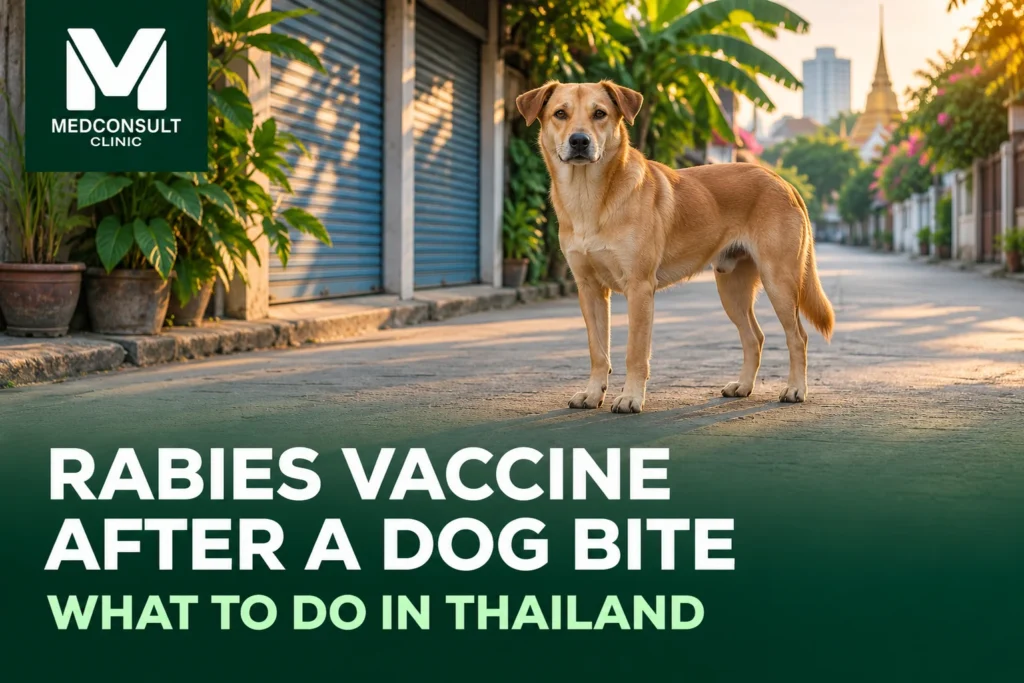
After a dog bite or scratch in Thailand, wash the area with soap and running water for at least 15 minutes and seek medical care immediately, ideally the same day. Do not wait for symptoms or for the dog to become unwell. If bleeding is heavy or cannot be controlled, apply firm pressure with a clean cloth and go straight to an emergency department.
Getting a rabies vaccine after a dog bite in Thailand can be part of potentially life-saving treatment. Depending on the exposure and your vaccination history, care may also include rabies immunoglobulin, wound treatment and tetanus protection. Even a small wound deserves attention.
What to Do Immediately After a Dog Bite
Move away safely and clean the wound
Get to a safe place without approaching or trying to catch the animal. Wash every bite and scratch thoroughly using soap and plenty of running water for at least 15 minutes. If soap is unavailable, begin flushing with water rather than postponing cleaning. An appropriate antiseptic, such as povidone-iodine, may be used after washing.
Cleaning helps reduce contamination, but it does not replace assessment or preventive treatment. Do not try to seal the wound yourself with household glue or another improvised treatment. Let a clinician decide whether closure is appropriate.
Arrange medical care without delay
Go to a hospital or medical facility that can assess animal bites and arrange post-exposure care. Large or deep wounds and uncontrolled bleeding need emergency care. Bites involving the face, head, hands or feet also need prompt attention.
If you can obtain the owner’s contact details and the animal’s vaccination record safely, bring them. Do not spend time searching for documents or chasing the dog before getting treatment.
Why a Small Bite or Scratch Can Still Matter
Rabies spreads through infected saliva entering broken skin or a mucous membrane, such as the eyes or mouth. A wound does not need to be large to create an exposure. Thai disease-control authorities also warn about scratches and saliva contacting existing wounds.
An animal’s familiar appearance, young age or status as a household pet does not automatically remove the risk. Tell the clinician whether the animal was owned, whether it was behaving unusually and whether reliable vaccination records exist. These details contribute to the assessment; they are not reasons to dismiss an exposure yourself.
Rabies is almost always fatal once symptoms develop, while timely post-exposure treatment can prevent illness. Waiting to see whether you feel sick misses the purpose of prevention. The immediate decision is about the exposure that happened, rather than how well you feel afterwards.
Which Types of Contact Need Rabies Treatment?
The World Health Organization groups exposure into three categories. The table is a general explanation; a clinician assesses the actual contact, skin damage and vaccination history.
| Contact | Usual response |
|---|---|
| Touching or feeding an animal, or saliva on completely intact skin | Wash the exposed skin. Rabies post-exposure treatment is generally unnecessary when the history is reliable. |
| Minor scratches or abrasions without bleeding, or nibbling uncovered skin | Wound washing and prompt rabies vaccination. |
| Bites or scratches through the skin, or saliva contacting broken skin, eyes or mouth | Wound washing and prompt vaccination, with rabies immunoglobulin or an appropriate antibody product when indicated. |
“No blood” does not necessarily mean “no exposure.” If you are unsure whether the skin was broken, explain exactly what happened rather than deciding from the wound’s appearance alone.
What Is Rabies Post-Exposure Prophylaxis?
Post-exposure prophylaxis, often shortened to PEP, means treatment given after a possible exposure to prevent rabies. It combines wound care with vaccination and, for certain exposures, an antibody product.
The vaccine helps your immune system develop protection. Rabies immunoglobulin provides ready-made antibodies while that response develops. The two products have different roles, so receiving one does not automatically mean the whole treatment plan is complete.
Ask the treating team to explain which parts apply to you. A useful question is: “Have we covered wound care, vaccine and the decision about immunoglobulin?” Keep a written record of the answer alongside your vaccination dates.
MedConsult lists rabies products within its vaccination services in Bangkok. Availability and suitability need checking for the individual visit, especially when an antibody product or more extensive wound treatment may be necessary.
When Is Rabies Immunoglobulin Needed?
For a person without previous complete rabies vaccination, a bite through the skin commonly calls for immunoglobulin as well as vaccine. A clinician places the antibody product into and around the wound where appropriate. This is different from simply adding another routine vaccine dose.
If immunoglobulin is indicated but unavailable at the first facility, start the vaccine promptly and arrange access to the antibody product urgently. It can generally be added up to and including seven days after the first vaccine dose. That timing is counted from the first vaccination, not from the bite.
Do not interpret this window as a reason to wait. Ask where you can receive the product and how the referral will be arranged. If the bite happened earlier but vaccination has not started, seek assessment now rather than assuming that treatment is no longer possible.
How Many Rabies Vaccine Visits Will You Need?
There is no single schedule that fits every patient. The plan depends on previous vaccination, immune health, the product and whether vaccine is delivered into muscle or into the skin. WHO recognises both intramuscular and intradermal approaches when used according to an appropriate protocol.
“Day 0” means the day your first post-exposure vaccine is given. It does not necessarily mean the date of the bite. Ask the clinic to write actual calendar dates for every remaining visit, which is especially helpful if you are travelling between cities or countries.
If you previously completed a recognised rabies vaccination course, a shorter booster course is commonly used and immunoglobulin is generally not given. Incomplete records, some older courses and weakened immunity can change the assessment. Bring proof of the vaccines and dates rather than relying on memory alone.
Do not change the schedule yourself because another traveller received a different plan. Ask the clinician to explain the reason for your particular course.
Can You Wait Ten Days to See Whether the Dog Is Healthy?
No: in a rabies-risk setting, animal observation must not delay your medical assessment or indicated treatment. A healthy dog or cat may be observed for ten days under appropriate veterinary or public-health arrangements.
The treating clinician can use the animal’s condition, reliable observation or laboratory results to decide whether treatment can be adjusted. Do not stop a vaccine course independently because the owner says the dog looks fine.
If the animal becomes ill, dies or disappears, tell the treating facility promptly. Do not handle a sick animal or its body yourself. The ten-day observation approach is not a general rule for every animal species.
Wound Infection and Tetanus Need Separate Attention
A dog bite can cause bacterial infection or damage deeper tissues, even while rabies prevention is being arranged. Antibiotics may be used for an infected wound or selected higher-risk injuries, including deep punctures, crush injuries or wounds in vulnerable areas. Not every bite needs the same antibiotic plan.
Tell the clinician about diabetes, immune-suppressing treatment or other conditions that may affect healing. Seek another assessment if redness, warmth, swelling or pain increases, or if pus, an unpleasant smell or fever develops.
Tetanus protection is a separate decision. Animal bites can introduce saliva into a wound, making your tetanus vaccination history relevant. Depending on previous doses and the injury, a tetanus vaccine and sometimes tetanus immunoglobulin may be needed. A rabies vaccine does not protect against tetanus.
MedConsult’s GP services in Bangkok provide a route to medical assessment. Serious injuries still belong in an emergency department rather than a routine appointment queue.
Children, Pregnancy and Weakened Immunity
Rabies post-exposure care can be given to children, including infants. Pregnancy is not a reason to withhold necessary PEP. Tell the treating team about pregnancy, breastfeeding, previous vaccine reactions and any medical conditions so the plan is documented clearly.
People with weakened immunity may need an adjusted vaccine course and a blood test afterwards to check the antibody response. Mention cancer treatment, transplant medicines, immune-suppressing medicines and relevant diagnoses at the first visit. Do not stop an existing medicine yourself; the clinicians managing your care can coordinate any changes.
For children, an adult’s account may be incomplete. Explain any uncertainty about where the animal touched the child and whether there were scratches or saliva on broken skin.
What Side Effects Can Happen?
Possible vaccine effects include soreness, redness, swelling or itching at the vaccination site, as well as headache, nausea or muscle aches. Mild reactions are not usually a reason to abandon rabies PEP. Contact the treating team for help managing symptoms and completing treatment.
Difficulty breathing, swelling of the face or throat, collapse or other signs of a severe allergic reaction need emergency care. Tell staff immediately if symptoms develop while you are still at the facility.
Keep the vaccine record available if you attend another clinic. It helps the team identify what was given and assess the next step without guessing.
Finding Rabies Treatment in Thailand
The CDC’s Thailand travel-health chapter describes rabies vaccine and human rabies immunoglobulin as available in provincial and many district hospitals. This is a useful starting point, but it does not confirm stock at a particular clinic on a particular day.
When contacting a facility, state that you have had an animal bite or scratch and need post-exposure assessment. Ask about both vaccine and immunoglobulin, rather than asking only whether the facility offers travel vaccinations. If it cannot provide all necessary care, ask for an immediate referral.
In Bangkok, check MedConsult’s branch locations and contact details when arranging care. If the clinic is closed or cannot see you promptly, go to a suitable hospital. Waiting for your preferred branch to open is not a reason to postpone time-sensitive treatment.
What Affects the Cost of Treatment?
The total cost may include the medical assessment, wound cleaning or dressings, vaccine visits, immunoglobulin, tetanus protection and any treatment for bacterial infection. A single advertised vaccine price does not necessarily cover the entire course.
Ask for an itemised estimate and clarify whether the amount quoted is per vaccine dose, per visit or for a complete plan. If immunoglobulin is included, ask how the amount and cost are calculated for your treatment.
Keep invoices and clinical records for an insurance claim. A travel insurer may help identify a facility or explain reimbursement, but waiting for an insurance reply must not hold up urgent assessment. You can review MedConsult’s medical services when discussing the different parts of your care.
Continuing Treatment While Travelling
Tell the first clinician if you will leave Bangkok or Thailand before completing the course. Arrange the next facility before travelling and send your treatment record ahead when possible.
Ask for documentation showing the vaccine name, dates, dose, route and sites used, plus details of any immunoglobulin and the original exposure. Keep a clear photograph as a backup. These details help the next clinician continue an appropriate course and assess treatment already received.
If an appointment is missed, contact the treating team promptly. A short delay does not automatically mean restarting the entire course, but longer gaps need individual review. Do not double a dose, invent a replacement schedule or stop treatment because the wound has healed.
Preparing for an Appointment at MedConsult
Bring your identification, vaccination records, medicine list and any treatment notes from another facility. Write down when and where the bite occurred, which areas were injured, whether the skin broke and what cleaning or treatment you have already received.
For planned follow-up, use MedConsult’s appointment page and specify that you are continuing rabies post-exposure treatment. Include the next dose date so the clinic can check arrangements.
For a new exposure, call or attend a suitable facility promptly rather than waiting for a routine online booking response. The priority is timely assessment and access to every part of the treatment you need.
Vaccination services in Bangkok
Branch locations and contact details
Frequently Asked Questions
Do I need a rabies vaccine if the dog belongs to someone?
Ownership alone does not decide the answer. The clinician considers the contact, the animal’s vaccination history and whether reliable observation is possible. Seek assessment promptly and bring available records without delaying your visit.
What if the scratch did not bleed?
A minor scratch or abrasion without bleeding can still count as a rabies exposure. Wash the area and get it assessed. Saliva on fully intact skin is a different situation, so explain whether there was any broken skin.
Is it too late if the bite happened several days ago?
Do not assume that it is too late. Seek care now, even if the wound looks healed. A clinician can assess delayed treatment; waiting for symptoms is unsafe. Tell the team whether any vaccine has already been given.
Can antibiotics replace a rabies vaccine?
No. Antibiotics address bacterial infections and do not replace rabies vaccination or immunoglobulin when indicated. Wound care, tetanus protection and rabies prevention are separate parts of the assessment.
Can I finish the vaccine course after returning home?
Often yes, provided the next facility reviews your records and arranges the remaining treatment on time. Confirm the next appointment before departure. Carry the actual vaccine and immunoglobulin details, rather than only a receipt saying “rabies treatment.”
References
Sources checked 15 November 2026. Treatment depends on individual exposure, vaccination history, immune health and the protocol used by the treating facility.
- World Health Organization: rabies and exposure categories.
- World Health Organization: wound care and rabies immunisation.
- Thailand Department of Disease Control: rabies exposure and prompt care.
- CDC Yellow Book: rabies treatment for travellers.
- CDC: rabies post-exposure prophylaxis.
- CDC: rabies vaccine and immunoglobulin.
- CDC Yellow Book: Thailand and access to rabies care.
- NHS: animal bites and urgent wound care.
- NICE: antibiotic treatment for human and animal bites.
- CDC: wound care and tetanus prevention.
- CDC: rabies vaccine information for patients.
- NaTHNaC TravelHealthPro: rabies risk and prevention in Thailand